Svalbard meteorological observations since 1898 and 1912
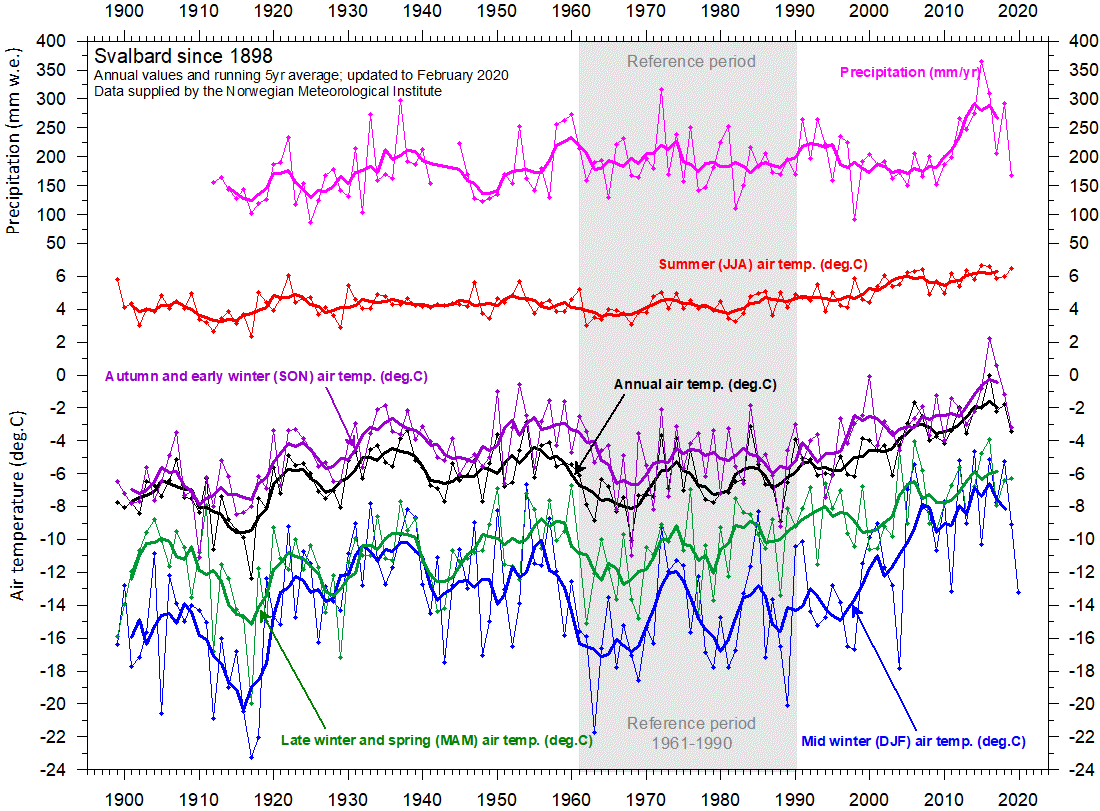
Svalbard meteorological observations since 1898. The thin lines indicate the annual values, while the thick line is the simple running 5-yr mean. Click here to read about running means and data smoothing. The diagram has been prepared using the composite monthly meteorological series homogenised by the Norwegian Meteorological Institute. The data may be downloaded from their official data access website, or from the Rimfrost.no website. Click here to visit a website illustrating some of the difficulties associated with stitching together the different Svalbard meteorological records. Last update: 2 March 2020.
-
Click here to see a simpler version of the above diagram.
-
Click here to see a comparison of models for Svalbard temperature development after 2010.
-
Open Climate4you homepage
Comments
Summer (JJA) surface air temperature is relatively constant, while all other seasons show large interannual variations, and control variations shown by the annual temperature. Especially the temperature relation between mid winter (DJF) and late winter and spring (MAM) has changed considerably over the observational period. Until 1926 MAM was clearly warmer than DJF, but in the following period, until 1944, these two seasons were almost equal as to air temperature. Since 1945, however, MAM again has been clearly warmer than DJF, especially during the two relatively cold periods 1958-1971 and 1976-1996. During the general temperature increase since 1997, the temperature difference between DJF and MAM has again decreased somewhat. The difference between DJF and MAM is seen to be controlled mainly by variations in the DJF air temperature. This varying relation between DJF and MAM therefore suggests that a change in sea ice conditions may be reflected in the temperature data. The Svalbard meteorological series consists of data obtained at four different measurement sites. These data series have subsequently been homogenised and stitched together (Førland et al. 1997). All meteorological stations, however, have been located near the coast, where modern observations suggest that variations in sea ice cover during the winter influence significantly on the air temperature recorded. Warm winter periods thereby partly may be the result of less sea ice than during cold winter periods. Had the meteorological stations instead being located inland, the warm winter periods would presumably have been recorded as somewhat colder.
Click here to read an analysis of the effect of the presence or absence of sea ice on recorded winter air temperatures in Svalbard.
The annual precipitation typically varies between 120 and 230 mm w.e., but the relation between air temperature and precipitation is complex. In contrast to simple physical expectations and the output from global and regional climate models, the relatively cold period 1955-1995 was characterised by a relatively high annual precipitation, and the warming period since 1996 has been characterised by decreasing annual precipitation. Presumably orographic effects derived from variations in the prevailing wind direction and wind speed may cause variations in the precipitation recorded. In addition, precipitation in windy Arctic areas like Svalbard is notorious difficult to measure and precipitation values are exposed to a high degree of uncertainty.
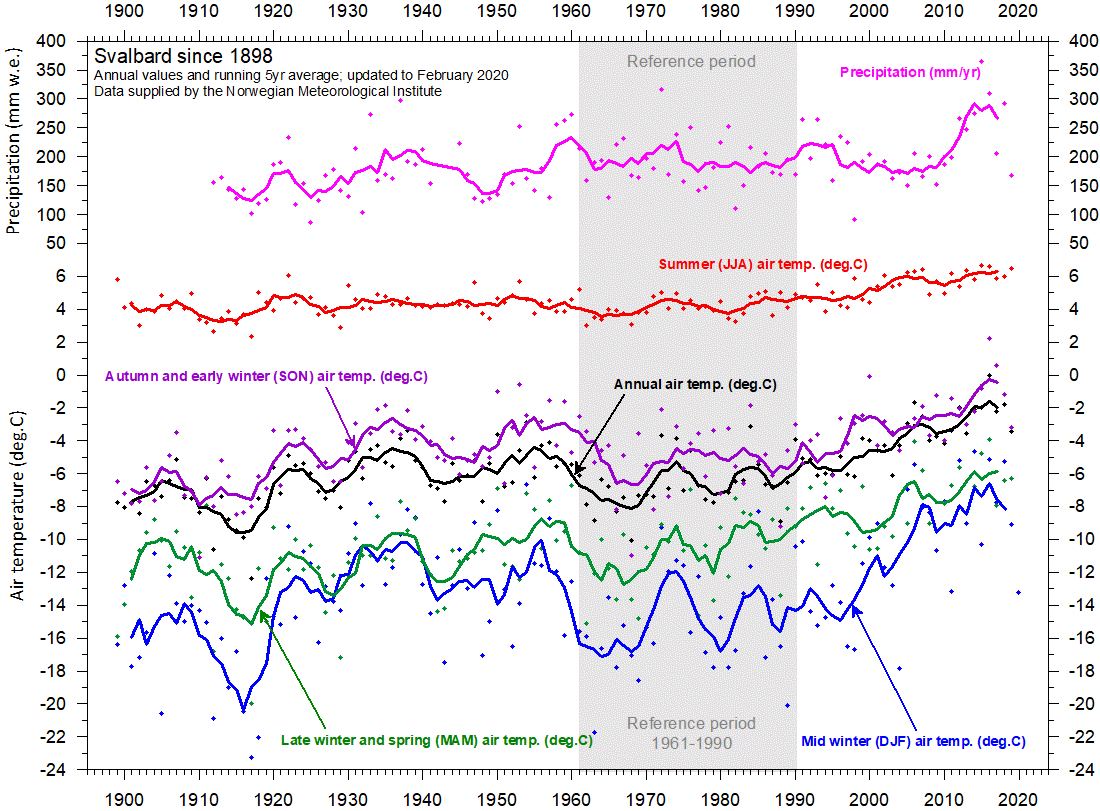
Svalbard meteorological observations since 1898. Points indicate annual values, while the thick line is the simple running 5-yr mean. Click here to read about running means and data smoothing. The diagram has been prepared using the composite monthly meteorological series homogenised by the Norwegian Meteorological Institute. The data may be downloaded from their official data access website, or from the Rimfrost.no website. Last update: 2 March 2020.
-
Click here to see a comparison of models for Svalbard temperature development after 2010.
See also some recent litterature on Svalbard meteorology:
Førland, E.J., Benestad, R., Hanssen-Bauer, I., Haugen, J.E., and Skaugen, T.E. 2012. Temperature and Precipitation Development at Svalbard 1900–2100. Advances in Meteorology. Volume 2012, Article ID 893790, 14 pages, doi:10.1155/2011/893790.
Humlum,
O., Solheim, J.-E., and Stordahl, K. 2011. Identifying
natural contributions to late Holocene climate change. Global and
Planetary Change 79, 145-158.
Humlum,
O., Solheim, J-E. and Stordahl, K. 2012. Spectral
analysis of the Svalbard temperature record 1912-2010. Advances in
Meteorology. Volume 2012, Article ID 175296, 14 pages,
doi:10.1155/2012/175296.
Nordli, Ø., Przybylak, R., Ogilvie, A.E.J., and Isaksen, K.. 2013 (submitted): Long-term temperature trends and variability on Spitsbergen: The extended Svalbard Airport Temperature Series 1898-2012.
Solheim, J-E., Stordahl, K.
and Humlum, O. 2012. Solar
activity and Svalbard temperatures. Advances in Meteorology. Volume
2012, Article ID 543146, 8 pages, doi:10.1155/2012/543146.
Solheim,
J-E., Stordahl, K. and Humlum, O. 2012. The
long sunspot cycle 23 predicts a significant temperature decrease in cycle 24.
Journal of Atmospheric and Solar-Terrestrial Physics. 80, 267-284,
doi:10.1016/j.jastp.2012.02.008.
Open Climate4you homepage